We were just beginning the portion of the trip - Santiago, Avila and Madrid - that had the most significance for me.
I mailed five postcards in Braga, including one to home. Father was frustrated with us for writing out and mailing postcards. I had written mine out days earlier and was waiting only for a place with a mailbox and stamps for sale. I suggested to Father that postcards are a form of evangelism. He graciously conceded the point.
After morning mass, First Saturday, which was moderately attended by the pilgrims in my group, we had breakfast. At 8:15 in the morning, it was still dark outside. The hotel's restaurant was on the tenth floor. By 8:45am, it was daylight despite having rained all day and still really teeming during breakfast.
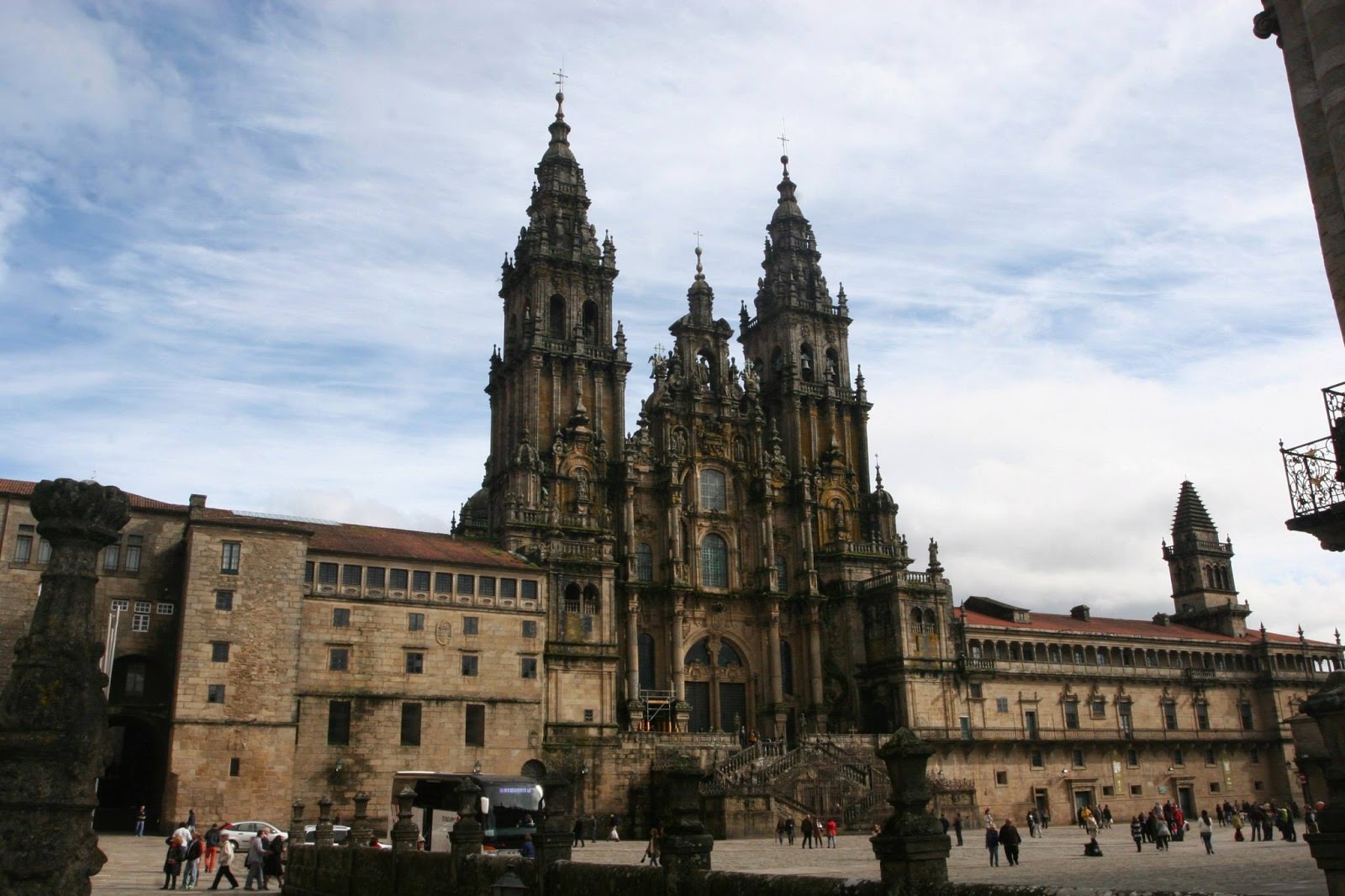
We took the bus from our hotel to Santiago cathedral.
The old city used to be walled in an oval but today most of the walls have become the side of a building. One city gate remains. Hospitals exist outside the city wall to care for pilgrims who may be ill as a kind of quarantine. We heard a bagpiper playing in an alcove out of the rain. I gave him some change, maybe a Euro altogether. Not much. Our guide said the bagpiper has only one pipe. She said these are Celtic influences in Gallicia, in fact, the Celts came from this part of Spain. Maybe that's why I feel such an affinity for this place.
Our guide named all the statues and figures on the facade of the church, including
Mary Salome, Mary's sister, making James and John Jesus' cousins.
Also, statues personifying the four cardinal virtues, Temperance, Justice, Prudence and Fortitude.
Temperance was figured mixing hot and cold water. Justice had a sword or rod or measuring stick. Prudence had a mirror. Fortitude had a stick or rod.
We walked around the interior of the cathedral. We came in the transept and saw the botafumeiro right away.
We saw St. James' sepulcher downstairs and hugged his statue upstairs.
A common image at the top of capitals is two birds drinking from the cup of life, like Eden.
I was anxious to get a seat for the noon mass because they were going to swing the thurible. I turned in my earphones to the guide and excused myself from the tour early. I said my rosary which was my penance from confession the night before and got a good seat on the aisle.
Some young people sat next to me and the transept filled up quickly. The mass was served by several priests and a wonderful nun cantor who had a great voice.
She led us in a practice of the psalm refrain and another song, maybe the entrance hymn. I did the best I could but the sound system did not help me understand her Spanish. The celebrant was old but forceful and convicted. He spoke with intensity, but I understood absolutely nothing. He mentioned
"Los Estados Unidos" several times in his opening remarks and I believe he was praying for pilgrims from that country
1.
He mentioned other countries as well. It was the noon mass for pilgrims. The mass followed the normal Saturday format: I recognized the readings from our English mass that morning in the hotel. During the sermon, I understood the priest to invoke the closing of the "Hail Mary" several times, like a refrain -
ahora y'a l'hora du muerta [sic] - "now and at the hour of death." Our recitation of the Creed took the form of renewing our baptismal promises. After each article of faith, we said,
"Si, credo." Mostly I understood what I was consenting to!
Communion went quickly but not orderly and the priest said nothing to me as he gave the host, maybe because he couldn't ascertain my language. It didn't seem like a personal interaction at all. I don't even think I said Amen, consequently. After, the men swung the botafumeiro which is an oversized thurible that swings from side to side along the transept, nearly touching the ceiling. You can see the red, burning coals inside, and the swinging seems to only fan the flames!


Our guide said that the west door was never open so most everyone entered by the transept doors - the "hands of Christ" - if one considers the church as a cross. She said that as a girl she walked through as a shortcut rather than walking around. She said that animals and people on horseback also cut through the church so in order to "clear the air" the thurible was swung. I'm not sure I buy her explanation but it was a solemn, quiet demonstration and not the circus atmosphere I observed a few months ago on YouTube when a priest at St. Mark's down the Shore described it. A very respectful demonstration - nothing liturgically offensive.
I was surprised to learn later that so few stayed for liturgy or to watch the botafumeiro. A few only popped in the church to catch a bit of the botafumeiro swinging! I don't get people at all. What else could they be doing?
1 As I write this from my travel diary almost a year after the fact, I now suspect the priest may have mentioned the United States because of Superstorm Sandy's aftermath. At the time, I had little idea of the devastation.